ソ連がバレンツ海に移植したタラバガニ、漁業資源としての成功と海底生態系への影響
Red King Crab Introduced to the Barents Sea by the Soviet Union: Commercial Success and Ecological Consequences
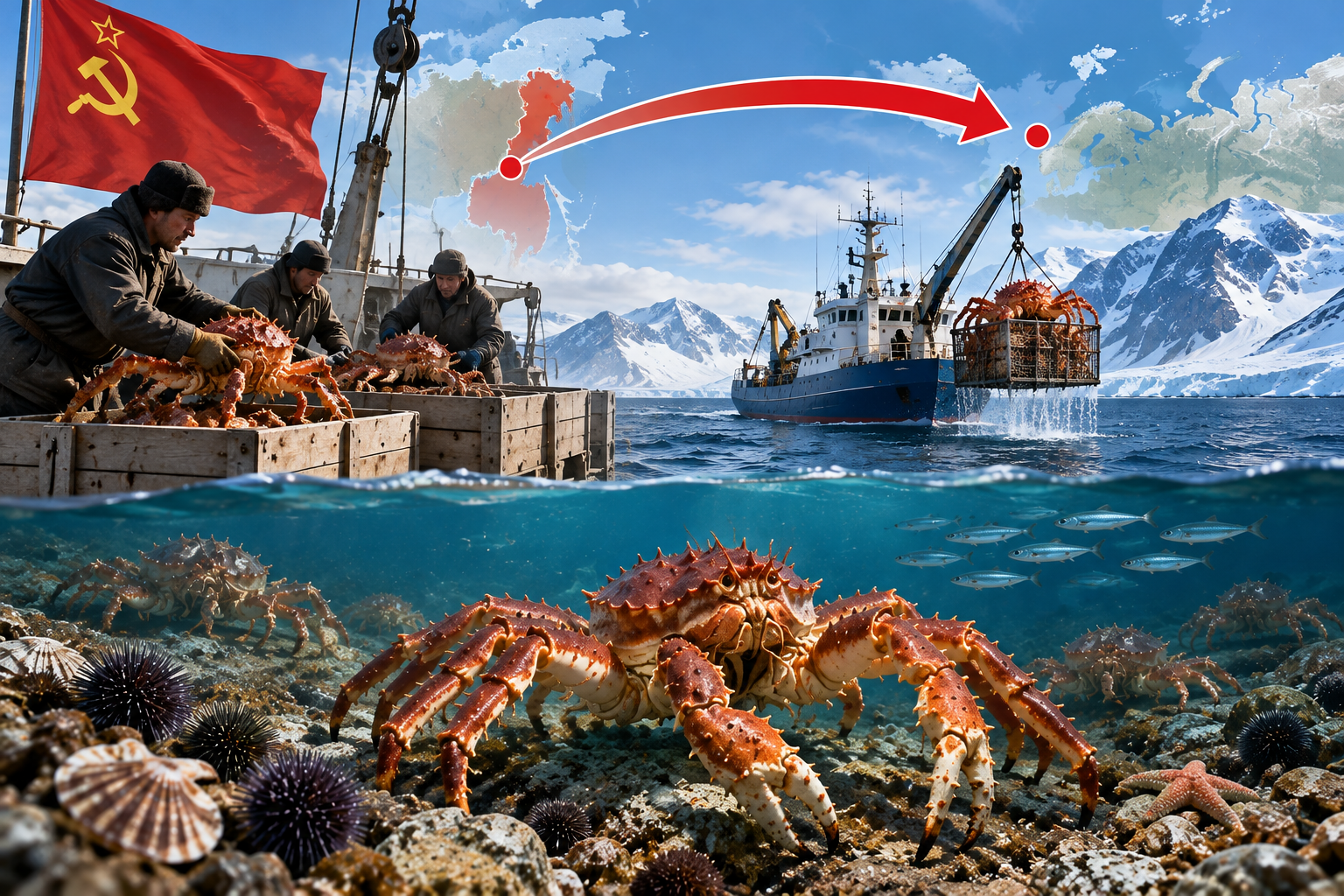
ロシアの情報配信サイト「Dzen」に掲載された記事によると、1960年代、ソ連は新たな漁業資源の開発を目的として、極東に生息するタラバガニをバレンツ海へ移植した。
ノルウェー海洋研究所(HI)の報告書によると、1961年に150万匹の幼生が放流され、その後1969年までに幼体1万匹と成体2,609匹が放流された。さらに1977~1978年には成体1,200匹が追加放流され、タラバガニは新たな環境に定着して分布域を拡大した。
商業漁業が本格化したのは移植開始から約40年後で、ノルウェーでは2000年代初頭、ロシアでは2004年に商業漁業が開始された。ロシアの研究機関ВНИРОによると、2020~2025年のロシア側の年間漁獲量は1万~1万2,000トンで安定し、2026年には科学的根拠に基づき1万4,500トンの漁獲量が算定されている。
しかし、タラバガニの増加は海底生態系にも影響を及ぼしている。ノルウェー沿岸の調査では、貝類、ウニ、ヒトデ、ゴカイ類などの減少が確認され、海底の泥をかき混ぜて酸素を供給する生物が減ることで、底質環境が悪化する可能性も指摘されている。
タラバガニは魚卵も捕食するが、Dzenの記事によると、カペリンの資源加入に重大な影響を及ぼしていることは、これまでの研究では確認されていない。
一方、同記事では、2020年以降、ロシア海域で漁獲対象となる大型雄の資源量が減少傾向にあり、移植後の急激な資源増加が終息しつつある可能性にも言及している。
ノルウェーでは、ロシアに近い東部海域でタラバガニ資源を保護する一方、西部海域では生態系への影響を抑えるため、漁獲枠を設けず、捕獲したタラバガニの再放流も禁止している。
ソ連時代に始まった移植事業は、商業漁業として成功を収めたものの、約60年を経た現在、資源の持続的利用と海底生態系の保全という二つの課題を残している。
出典・参考資料
Dzen(ロシア)
「В СССР переселили камчатского краба в Баренцево море. Что из этого вышло」
https://dzen.ru/a/asrS1I-n_QxJ427J
ノルウェー海洋研究所(HI)
「Alien marine species in Norway」(2022年)
https://www.hi.no/hi/nettrapporter/rapport-fra-havforskningen-en-2022-8
ロシア全ロシア漁業海洋学研究所(ВНИРО)
「Научный сотрудник ВНИРО рассказал об истории интродукции камчатского краба в Баренцево море」(2026年5月18日)
https://vniro.ru/index.php/ru/novosti/nauchnyj-sotrudnik-vniro-rasskazal-ob-istorii-introduktsii-kamchatskogo-kraba-v-barentsevo-more
※本記事はロシアの情報配信サイト「Dzen」の記事をもとに、ノルウェー海洋研究所およびВНИРОの公表資料を参照してまとめたもの。研究結果の詳細や数値の根拠については、各研究機関の一次資料を確認されたい。
According to an article published on the Russian online content platform Dzen, the Soviet Union introduced red king crab from the Russian Far East into the Barents Sea in the 1960s to develop a new commercial fishery.
According to a report by Norway’s Institute of Marine Research (IMR), approximately 1.5 million larvae were released in 1961, followed by 10,000 juveniles and 2,609 adults between 1961 and 1969. An additional 1,200 adults were released in 1977–1978. The crabs successfully established themselves in the new environment and gradually expanded their distribution.
It took approximately 40 years for the introduced population to support a commercial fishery. Commercial fishing began in Norway in the early 2000s and in Russia in 2004. According to Russia’s Russian Federal Research Institute of Fisheries and Oceanography (VNIRO), annual Russian catches remained stable at 10,000–12,000 tonnes between 2020 and 2025. For 2026, a scientifically justified catch level of 14,500 tonnes has been established.
However, the expansion of red king crab populations has also affected the marine ecosystem. Studies along the Norwegian coast have documented declines in shellfish, sea urchins, starfish, and marine worms. Researchers have suggested that the loss of organisms responsible for mixing seabed sediments and facilitating oxygen penetration may contribute to the deterioration of seabed conditions.
Red king crabs also feed on fish eggs. However, according to the Dzen article, previous research has not identified any significant impact on the recruitment of capelin stocks.
The article also reports that the exploitable biomass of large male red king crabs in Russian waters has been declining since 2020, suggesting that the rapid population growth following their introduction may be coming to an end.
Norway has adopted two different management approaches. In eastern waters near the Russian border, red king crab stocks are managed to maintain a commercially valuable fishery. In western waters, however, fishing is permitted without catch quotas, and releasing captured crabs back into the sea is prohibited to limit their further spread and reduce ecological impacts.
The Soviet-era introduction of red king crab has become a commercial success. Nevertheless, approximately 60 years later, it continues to present two major challenges: ensuring the sustainable use of the resource while protecting the native marine ecosystem.
Sources and References
Dzen (Russia)
“В СССР переселили камчатского краба в Баренцево море. Что из этого вышло”
https://dzen.ru/a/asrS1I-n_QxJ427J
Institute of Marine Research (IMR), Norway
“Alien Marine Species in Norway” (2022)
https://www.hi.no/hi/nettrapporter/rapport-fra-havforskningen-en-2022-8
Russian Federal Research Institute of Fisheries and Oceanography (VNIRO)
“Научный сотрудник ВНИРО рассказал об истории интродукции камчатского краба в Баренцево море” (May 18, 2026)
https://vniro.ru/index.php/ru/novosti/nauchnyj-sotrudnik-vniro-rasskazal-ob-istorii-introduktsii-kamchatskogo-kraba-v-barentsevo-more
Note: This article is based on a report published on the Russian online content platform Dzen, supplemented by publicly available information from Norway’s Institute of Marine Research (IMR) and Russia’s VNIRO. Readers seeking more detailed scientific findings and supporting data are encouraged to consult the original research publications and official reports.