バレンツ海カペリン、2027年も禁漁勧告―資源量は過去2番目の低水準
Barents Sea Capelin: Zero Catch Recommended for 2027 as Stock Falls to Second-Lowest Level on Record
2026年に実施された生態系調査では、バレンツ海全域でカペリンの分布量が少なく、特に従来から重要な索餌海域となっているStorbankenおよびその周辺で、極めて少ないことが確認された。
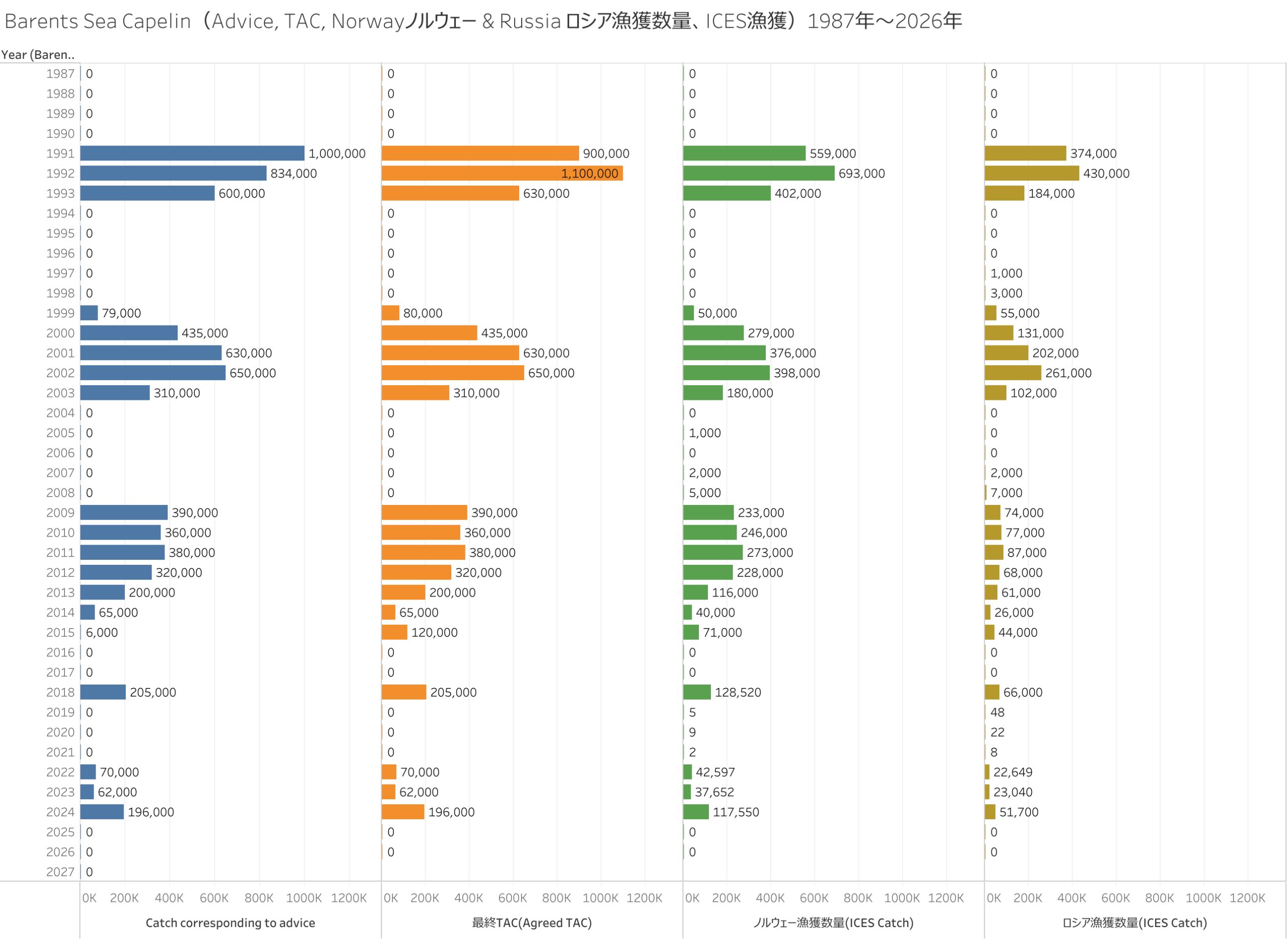
成熟資源量は、1972年に体系的な調査が開始されて以来、過去2番目の低水準となり、これを下回ったのは1987年のみであった。
『カペリン資源が新たな崩壊期に突入』
2020年以降に生まれたカペリンの年級群は、いずれも低水準で推移しており、未成熟魚および0歳魚の資源量も長期平均を大幅に下回っている。
また、同じ期間にバレンツ海では若齢ニシンが大量に分布しており、カペリンの新規加入に悪影響を及ぼしている可能性が指摘されている。
カペリン資源評価を担当する研究者Georg Skaretは、現在の資源状況について、新たな崩壊期に入っており、回復までには時間を要する可能性があると説明している。
過去にも、1980年代後半、1990年代半ば、2000年代半ばに、カペリン資源が数年間にわたり低水準となる時期が確認されている。
『資源回復の見通しと2027年の漁獲枠』
カペリン資源は現在、極めて低い水準にあるものの、過去の事例では、新規加入に適した環境条件が整えば、比較的短期間で急速に回復する傾向が確認されている。
しかし、近年の年級群が継続して低水準にあることから、今後の資源回復には不確実性が残る。
2027年の最終的な漁獲枠は、ノルウェー・ロシア漁業委員会によって決定される。
今回の勧告どおり漁獲量ゼロが採用された場合、バレンツ海のカペリン漁は3年連続で禁漁となり、同海域からのカペリン供給が引き続き停止することになる。
出典:ノルウェー海洋研究所(Havforskningsinstituttet:HI)
2026年10月19日
https://www.hi.no/hi/nyheter/2026/oktober/tilrar-fortsatt-fiskestopp-for-lodde-i-barentshavet-i-2027
The Norwegian Institute of Marine Research (IMR) has recommended a zero catch for capelin in the Barents Sea in 2027, marking the third consecutive year of such a recommendation.
According to the 2026 ecosystem survey, capelin abundance in the Barents Sea remains extremely low, particularly in the traditionally important feeding areas around Storbanken.
The mature capelin stock is now at its second-lowest level since systematic surveys began in 1972. Only 1987 recorded a lower level.
『Capelin Stock Enters Another Period of Collapse』
Capelin year classes since 2020 have been weak, while the abundance of both immature capelin and young-of-the-year fish remains well below long-term averages.
During the same period, large numbers of juvenile herring have been present in the Barents Sea, which may have negatively affected capelin recruitment.
IMR researcher Georg Skaret, who is responsible for capelin stock assessments, stated that the stock has entered another period of collapse and that recovery may take time.
Similar periods of prolonged low capelin abundance were recorded in the late 1980s, mid-1990s, and mid-2000s.
『Stock Recovery Outlook and 2027 Catch Quota』
Although the capelin stock is currently at an extremely low level, historical observations show that it can recover rapidly when conditions are favorable for successful recruitment.
However, the continued weakness of recent year classes suggests that uncertainty remains regarding the timing of recovery.
The final catch quota for 2027 will be determined by the Joint Norwegian-Russian Fisheries Commission.
If the zero-catch recommendation is adopted, the Barents Sea capelin fishery will remain closed for a third consecutive year, and capelin supplies from this fishing area will continue to be unavailable.
Source: Norwegian Institute of Marine Research (IMR), October 19, 2026
https://www.hi.no/hi/nyheter/2026/oktober/tilrar-fortsatt-fiskestopp-for-lodde-i-barentshavet-i-2027